Mrs Weaver’s Motivation
*
Mrs Weaver’s Motivation *
Mrsf
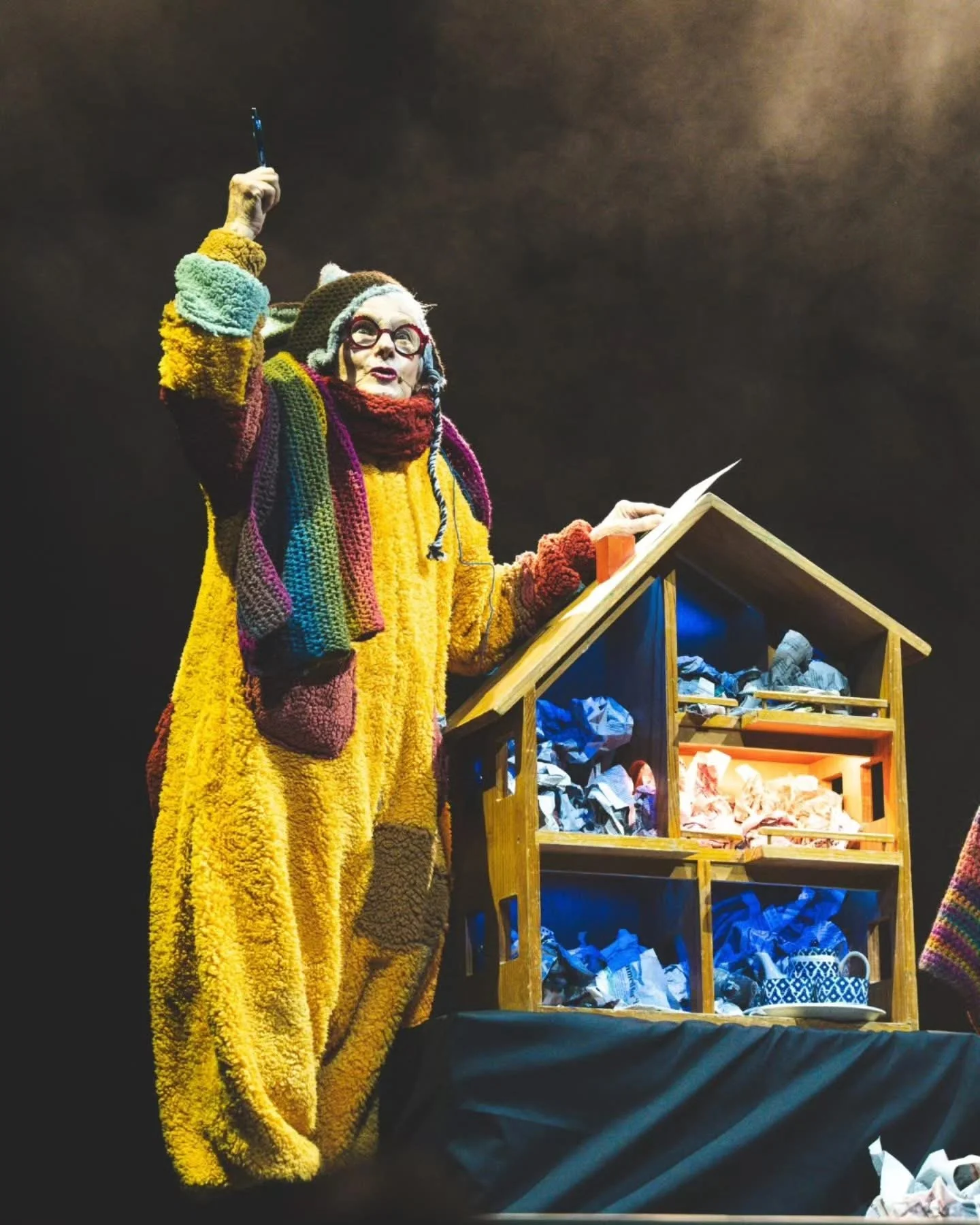
ABOVE PHOTO BY DEAD PUPPET SOCIETY, 2025
MRS WEAVER SPEAKS
We must “…get in good trouble, necessary trouble, and help redeem the soul of [the world] …good trouble stories help us act, in pursuit of social justice” (John Lewis, Civil Rights Activist)
We are out there on the high wire of all of our possible futures, and we belong there. The gods want us there because they want something more of us than the comforts and certainties of our timorous egos. (James Hollis, Hauntings)
I draw inspiration from fiction and philosophy. I then wed them to three areas of exploration:
Personal stories lend emotional realism; then
Social and Political stories ground the piece in real-world problems; and finally,
Mythological resonances offer an engaged, universal lens.
My playwrighting framework, initially emerging from my PhD, focused on these three areas. However, the point of difference with Mrs Weaver is that I have added, thanks to Dead Puppet Society,
Design as a fourth frame. Design opens the theatrical world to magic and mystical engagement, guiding the story forward.
STYLE OF THE WORK:
MAGICAL, MYSTICAL, HUMOROUS
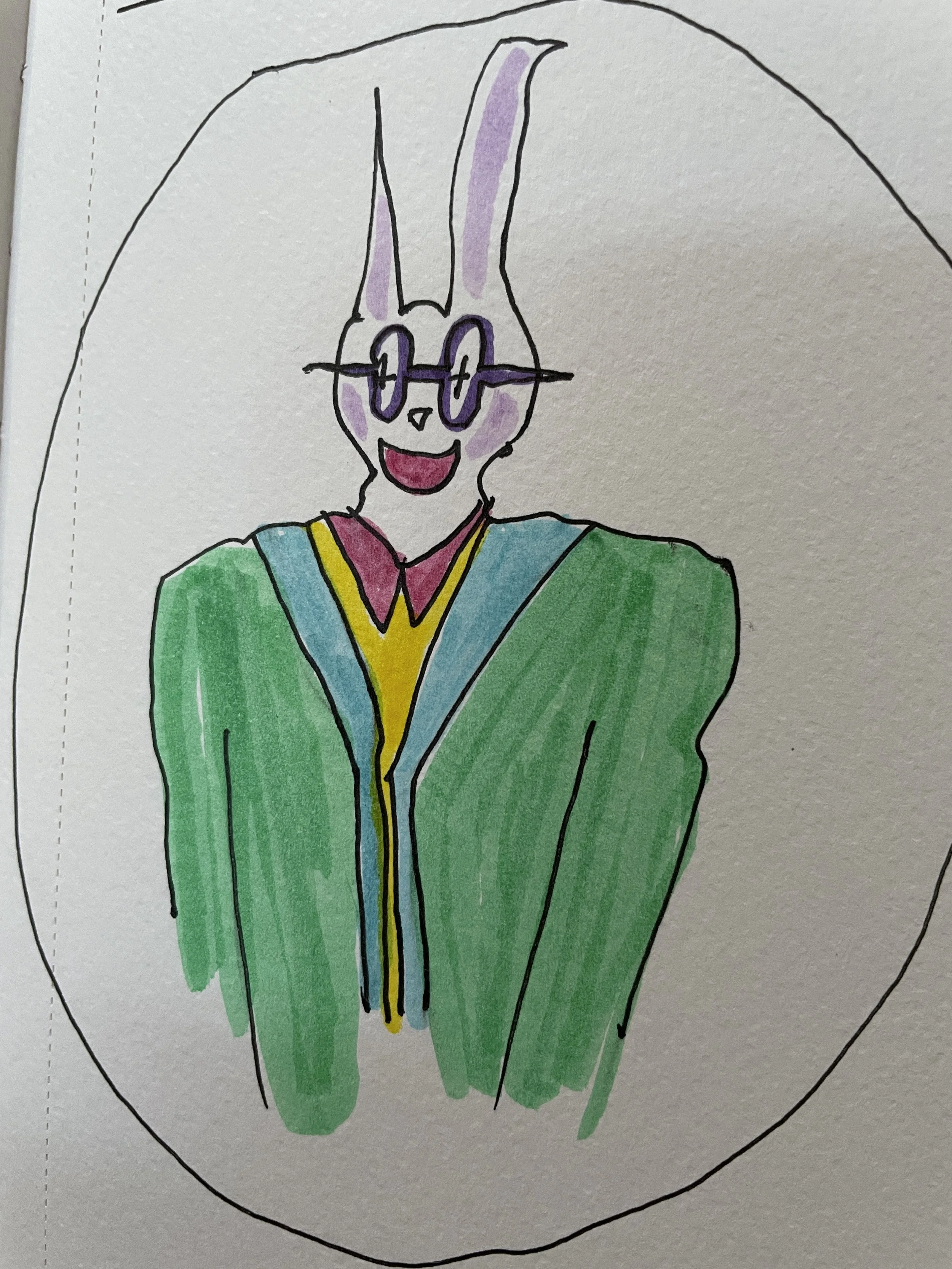
I have usually written the whole script, in collaboration, before getting it up on the floor. While working with Dead Puppet Society in July/August 2025, I was asked, "Why don't you work from design rather than text?" This was challenging, and because of the challenge, Mrs Weaver was born. So far, the script has emerged from the puppet Hare, and Hare's relationship to Mrs Weaver; a collection of newspapers; an old doll’s house my kids owned; a tea set and a book. In the future, as the story unfolds, we will see Bird, Platypus, Bee, and Dog, and perhaps even Snail, teach Mrs Weaver the wisdom she is seeking. The animals will wake her up. The play will use 'direct address' to the audience, which is my preferred way of performing: as though the chat is happening inside a cosy home while also taking place in a land of make-believe. The design takes us to the Moon, to upside-down houses, topsy-turvy worlds, and floating platforms. Mrs Weaver gets to experience life as Hare, and perhaps as Bee, Bird, or Dog, in her search for peace and wisdom, so that the world can live at ease once again, reconnected with Nature and each other.
So, Who Is Mrs Weaver (she’s no saint, that’s for sure),
and what story does she want to tell?
Mrs Weaver is 70 years old. Her ancestry is Celtic, and she believes she stands at the threshold of a thin space, a magical spot right on the edge of life. A place of pause, so that audience, cast, and creatives alike can look at the world with fresh eyes and recover their sense of wonderment for this miraculous planet. Not a bad brief ("But a near-impossible one, “ I whisper under my breath).
Mrs Weaver is about to take us on a journey of discovery. She finds herself dancing and stumbling with questions that haunt her threshold, such as how to live well and do no harm, how to help others, and make a difference. She is not entirely of this world, nor the next, posed in the space between what is expected of her and her desire to shake up the system. She wants to awaken the good trouble stories that must be woven into the world’s blanket of belonging. But with the shifting of politics, it’s a challenging request.
How Does She Get It?
1. WEAVER OF GOOD TROUBLE STORIES: Mrs Weaver wants to weave a blanket of Good Trouble Stories to cloak the Earth, and right the wrongs of our decaying Western world. The problem is she’s not a good weaver. And she can’t even find the good trouble stories. They have been struck dead by the news, and instead, the bad trouble stories expand and dominate. She's had enough, and it's time to change. But how?
2. VALUE OF THE ELDER: She's a quintessential and eccentric grandmother, and like all older women, she knows it doesn't matter whether you have birth grandchildren or are grandmother to the creatures and people you've gathered throughout your long life: Grandmothers can change the world. But she is lonely, just like so many others in the world. Eldership is no longer valued in the West. She believes that if all grandmothers united, profound change could occur.
3. HER ANIMAL NEIGHBOURHOOD: Her closest neighbour is Mr Hare, who lives across the paddock and through the forest. Bee lives in the opposite direction; take the path to the left, not the right. Bird lives around the corner from her house, nesting in the large jacaranda. Platypus visits occasionally (he's a bit of a misfit). Oh, and then there's Snail. You can guess what Snail has to teach her.
4. SHE’S HARD TO GET ON WITH: She is isolated from other humans. She’s having trouble relating (is she hard to get on with?). She believes in inter-being, or interconnectedness, and wishes others would too.
5. SHE MUST CHANGE HER WAYS: Through her interactions with these animals and creatures, Mrs Weaver learns that the very things she wishes to change in the world must first be altered within herself. She has a philosopher’s mind and remembers Carl Jung's suggestion that if there is something we want to change, we should first examine it and see whether it is something that could be better changed in ourselves. How do we change ourselves, thinks the Weaver, and her thoughts became words, which then result in actions. 'Right' thinking makes the world a better place.
6. RIGHT THINKING and SELF REFLECTION: 'Right' thinking or 'correct' thinking is something that Mrs Weaver struggles with. She wants to feel good trouble thoughts, but every time she does, she gets bombarded with bad trouble stories. And these bad trouble stories awaken the monster within her. She's beginning to forget things. Her bones ache, and her head feels scrambled sometimes. She even struggles to stay awake. What Mrs Weaver needs to learn is that she must face her truth and fully accept the reality she finds herself in. She needs to closely examine her own actions and decisions before intervening in something she’s not well-versed in.
7. DETERMINED TO RESIST: To begin, she's determined to create a home of peace and togetherness. In her better moments, she dreams of building a community of resistance—no violence, no hate, no despair —until the newspapers arrive with the morning dew and squash all her plans, plunging her into deep despair. Her Monster is back.
Throughout the 70-minute performance, Mrs Weaver and her audience delight and despair in stories where Mrs Weaver struggles to focus on the values necessary for a healthy world, such as
a. The importance of showing up for each other, even though sometimes it's hard.
b. Believing in values such as caring, accepting differences, and being open to the magic the world offers if only we believe. And sometimes it's nearly impossible to believe.
c. Sharing from the heart and hosting friends with grace, even when it feels impossible.
d. And most of all, embracing the 'good trouble stories' that are necessary to create transformative change.
e. Mrs Weaver wants to wake up the world, and she will do this by examining her own Monsters, finding a way to shift them so that good things can happen.
e. Oh, in her first story, she does go to the Moon, with the help of Hare and the Moonbeam, “A most comfortable place to sit”.
f. And of course, there are many stories that Mrs Weaver hasn't written yet, stories and ideas that the Creatures and Nature teach her.
WIDER SOCIAL THEMES
LONELINESS: There is a massive epidemic of loneliness across Australia, particularly since the COVID-19 pandemic. According to a Parliamentary Inquiry, loneliness is a risk factor for poor mental and physical health, including an increased risk of death and dementia.
LACK OF HARMONY WITH NATURE: A study published in ScienceDirect found that more than 60% of Australians reported a LACK OF HARMONY WITH NATURE, an essential element of human health and sustainability, contributing to Climate Chaos. Climate Change. Ignorance and Fear: “The physical and psychological connections people have with nature are crucial for both human well-being and environmental health”.
The whole world is dying.
She knows this in her bones.
The new world is waiting to grow
She knows this, too.
So, now, there are Monsters.
SHE HAS A NECESSARY JOB TO DO: Mrs Weaver believes that grandmothers-of-the-world have a tremendous job ahead of them: there is a reason why they live for 40 or so years after menopause. These years are to be dedicated to initiating and educating their descendants, real and imagined. They need to step into wisdom, listen deeply, and use thoughtful language around the big and small conflicts of the day —and, oh my, we have so many, don't we?
BUT SHE IS LONELY: Despite her awareness, or lack of it, Mrs Weaver is lonely. She doesn't yet know that one in three people in Australia also suffers from loneliness.
Life is Connection, she sniffs.
Life is about Connection.
But sometimes the Connection is not there.
Nothingness is there.
Just the empty hall and the closed door
AND SHE IS FEARFUL: Remember what Philip Larkin wrote about fearing nothingness?
No sight, no sound
No touch, taste, or smell, nothing to
Think with
Nothing to love or link with…(Philip Larkin)
SHE NEEDS FRIENDS: To live, we link with others. Other people, animals, and birds (they are singing right now, just outside Mrs Weaver's window). So, birds, Insects, even. Mrs Weaver identifies with the English philosopher Derek Parfit, who once saw his life like a "glass tunnel through which [he]…was moving faster every year, and at the end of which there was darkness". What if, rather than the self being all about 'who you are', what if the self were only the self when in relationship with others? Is that what Mrs Weaver learns? Building relationships with both humans and non-humans adds meaning to life. But Mrs Weaver has lately become aware that her friendship group is shrinking to almost nothing. And her Monsters are lurking.
SHE STRIVES FOR PERSPECTIVE: In her dream, Mrs Weaver perches on the Moon. It's cold, and the cold is beginning to concern her. She rubs her legs briskly, slaps her back, and joins her hands together as if to say, "help me, gods", and her eyes begin to adjust to the vastness that surrounds her. She looks down at the Earth from her perch, taking in the vastness that surrounds it and the smallness of this blue ball, home to people, animals, plants, and countless other things.
"I can't see any conflict from up here", she says.
"You, dear Earth, are totally interconnected. You all share a beautiful earth, let's get on with each other"
She softly sings:
I see the Earth,
The Earth sees me
God bless the Earth
And God bless thee.
Mrs Weaver would like to be a powerful force; otherwise, someone else will design her life, and she'll disappear into the yellow wallpaper and fall into Alice's enormous black hole. Mrs Weaver doesn't want to breathe just a little and call it a life (Mary Oliver said that), and she doesn't want to measure out her life in coffee spoons, thank you very much, T.S. Eliot!
Rooted in purpose, shaped by vision, driven by results. Welcome to a space designed for ideas that move people. With a focus on quality, clarity, and connection, we're here to help you make an impact that lasts.