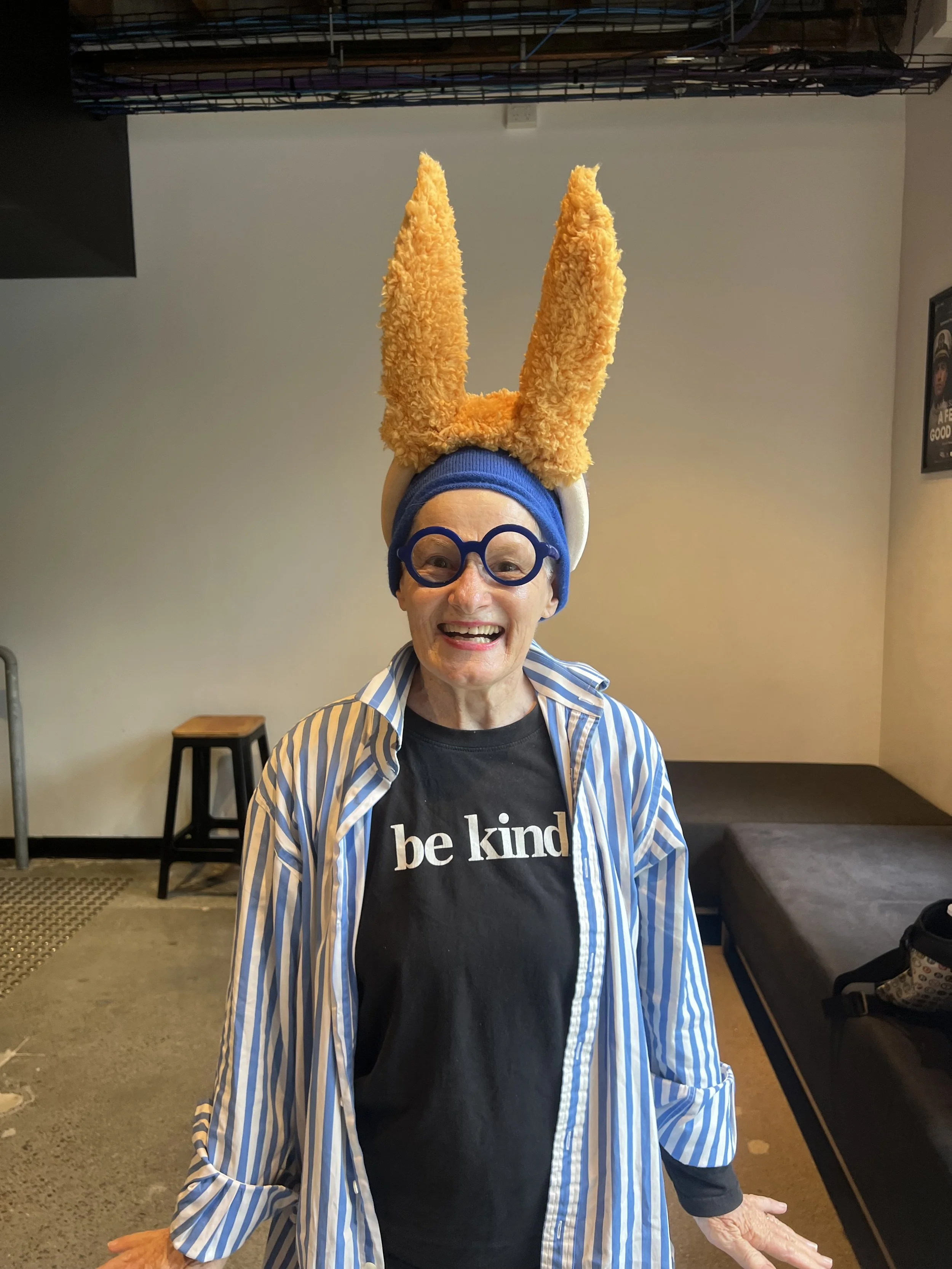
MRS WEAVER AT THE END OF THE WORLD
*
MRS WEAVER AT THE END OF THE WORLD *
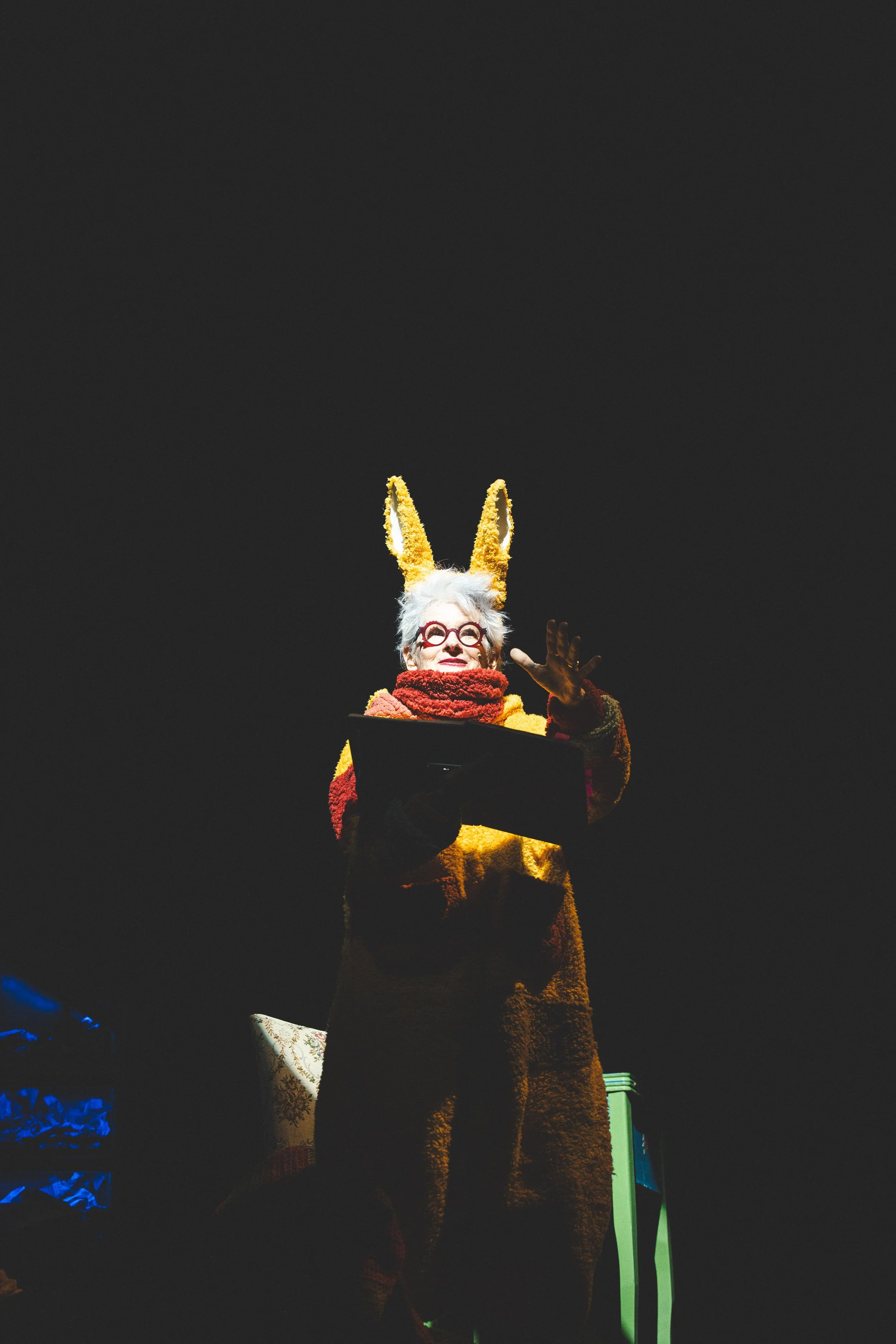
BELOW YOU WILL FIND:
A trailer of our very first creative development at Princess Theatre, as part of the showing of Dead Puppet Society’s Academy, August 2025. Trailer is taken from our Archival.
https://youtu.be/qyKYFW5jRV
2. The Draft of Act 1
MARGI: (Voiceover, up high US. Her face is lit by the light of the moon) I haven't been out of my house for months now. It's far too noisy. I've jammed my ears full of wool. I've sewn my eyes shut and I have hardened my heart. This is why I am here tonight, to see if being witnessed can melt my hardness.
Give me larger ears in order to hear more clearly and eyes that can see the world with balance. This is what I want for this night and so I…
SND: Piano by Trav
…must hand myself over to The Weaver of Stories and The Harbinger of Tricks.
Margi observes Hare, and then moves off treads
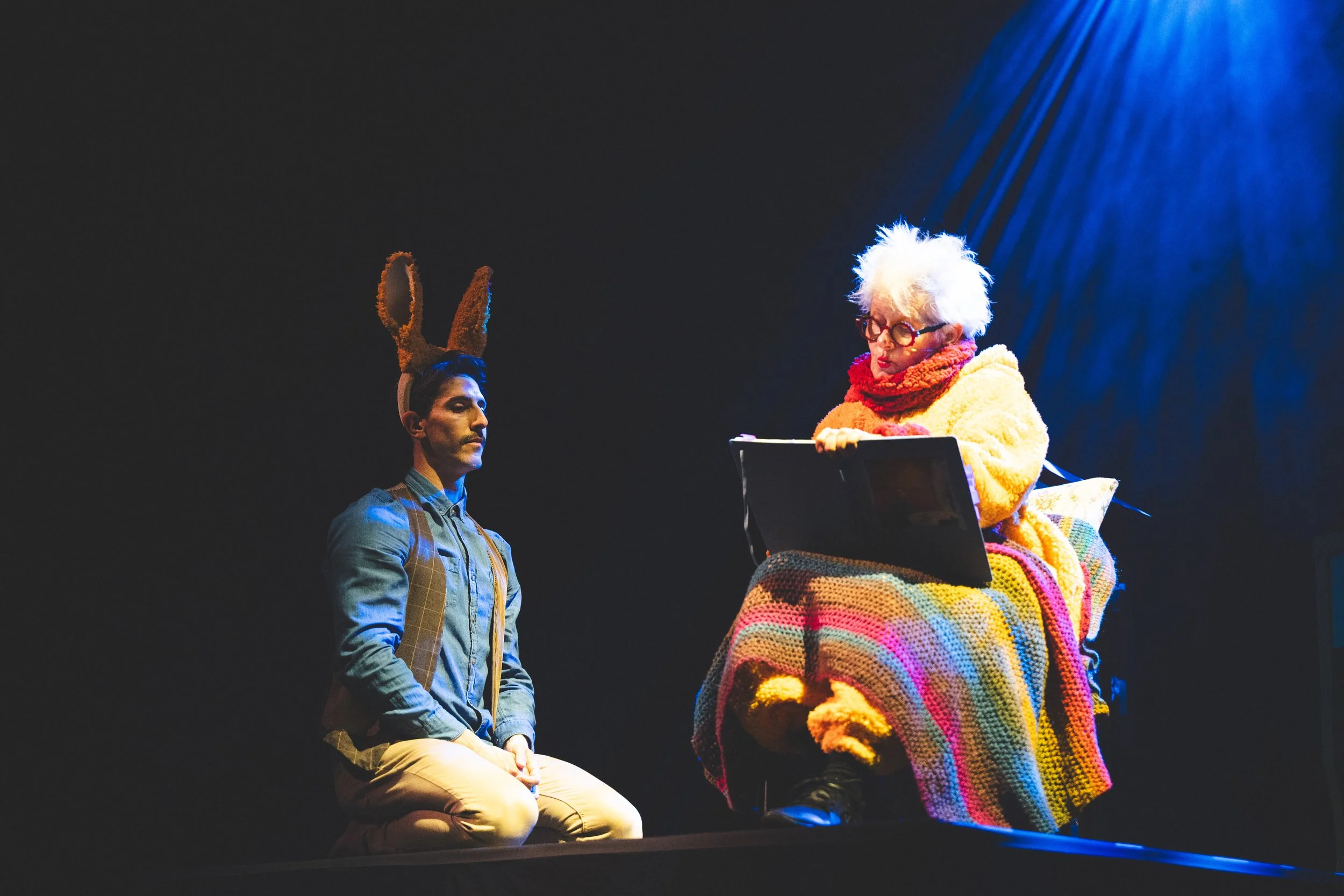
MARGI STORYTELLER: (Moving in a figure 8 around the space, Hare cleaning his paws in his nest) Once upon a time, a long, long time ago and only yesterday - you've heard that one before, haven't you?
Well, it's true, and it's not true. It's real, and it's not real.
(Referring to Hare) But we must make believe, for without belief, we come to nothing.
SND: Piano fades
(Moving again) So once upon a time…there is a Hare…
SND: Accordion music. (Hare begins dancing)
…he can run like the wind and shapeshift in a flash. One moment, he’s Hare, the next the Moon (Hare goes up the ladder), the Moon into an Old Woman. Whatever is needed, there he is. Now Hare, you play Dog and (cross to Trav) you…Storyteller…
(Hare becomes Dog. Lights up on Mrs Weaver’s chair with Dog asleep next to her)
TRAV STORYTELLER: And here she is, the Warrior of Worriers, Mrs Weaver, the Grump of Grumps…
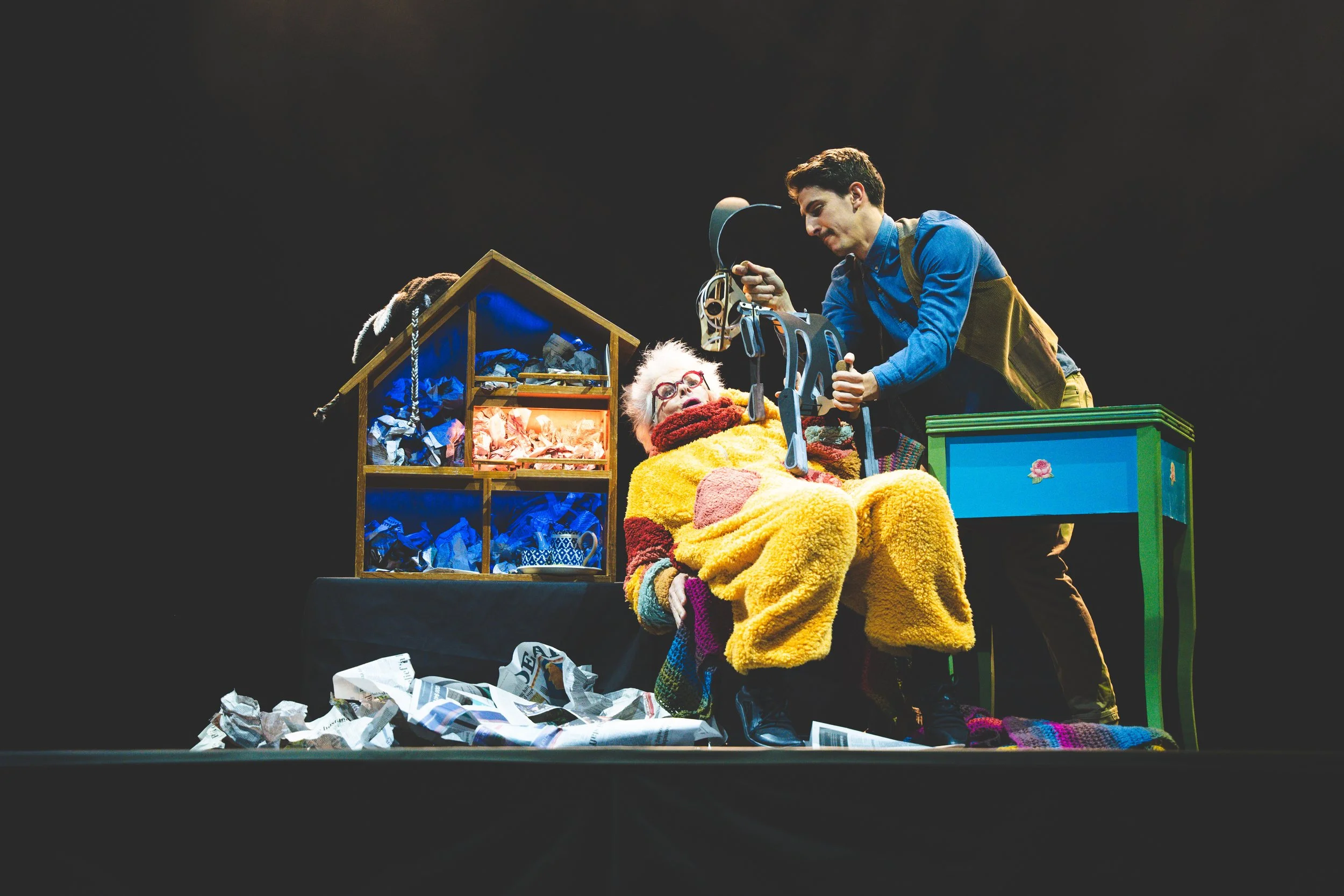
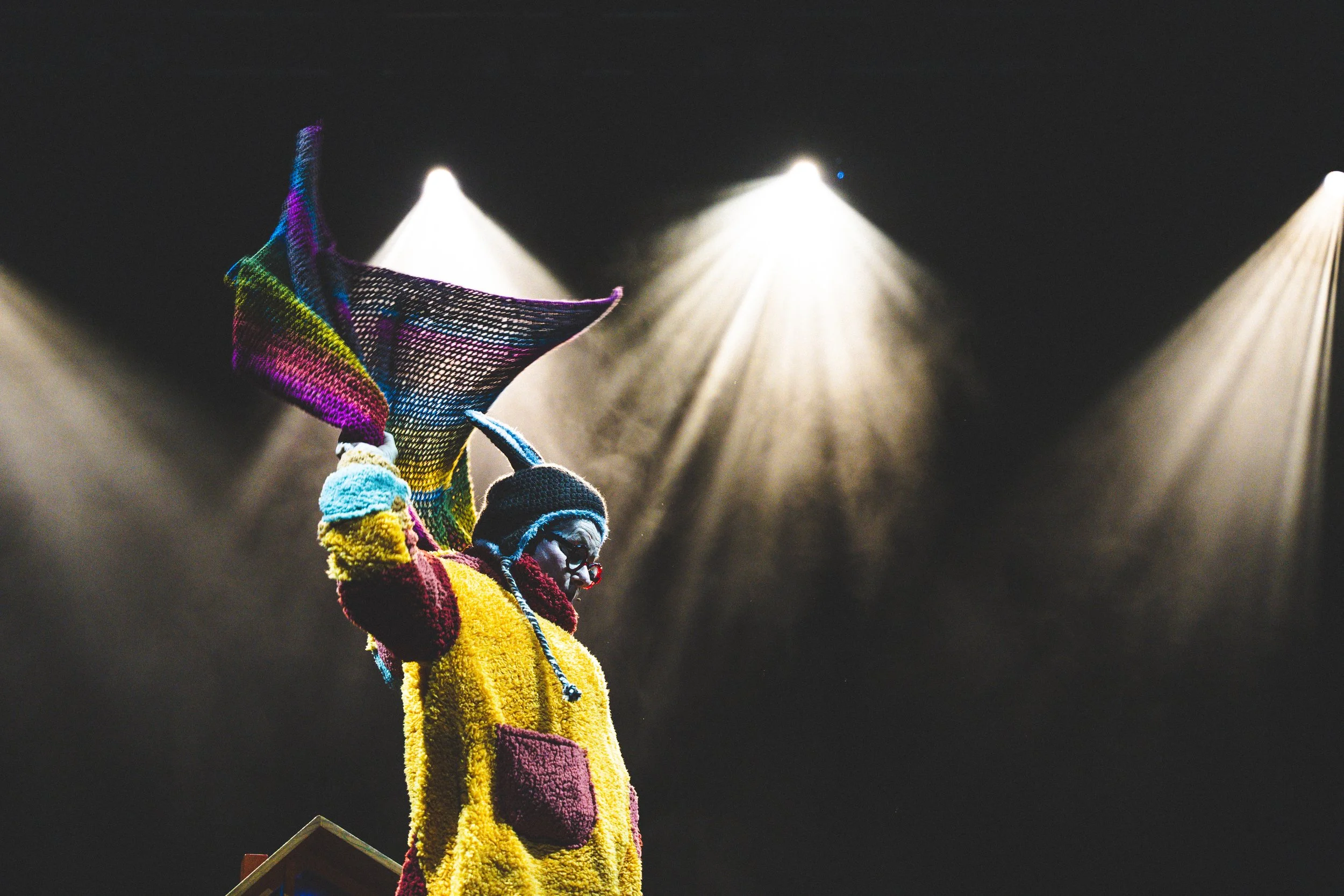
MRS WEAVER: (Newspapers on chair) Excuse me! Most of the time, I am A Very Happy Woman. I used to love digging in my garden and marking the seasons, and I have a beautiful pond where Platypus sometimes visits. I have a comfortable chair where I keep up with the news of the day and weave my blanket of good trouble stories. (She picks up her weaving and Dog hands her the crochet hook) Why, thank you!
(Dog barks) What did you say? (Dog barks) Dog calls it my life’s work.
SND: Accordion music while Mrs Weaver weaves, until she drops a stitch
MRS WEAVER: Oh drat! (Mrs Weaver throws weaving down, picks up newspapers from her lap, starts reading and then throwing them away)
TRAV STORYTELLER: Now, Mrs Weaver reads a lot, but lately, she’s been bombarded with bad-trouble stories: chaos, crooked leaders, floods, fire. All the good-trouble stories have disappeared.
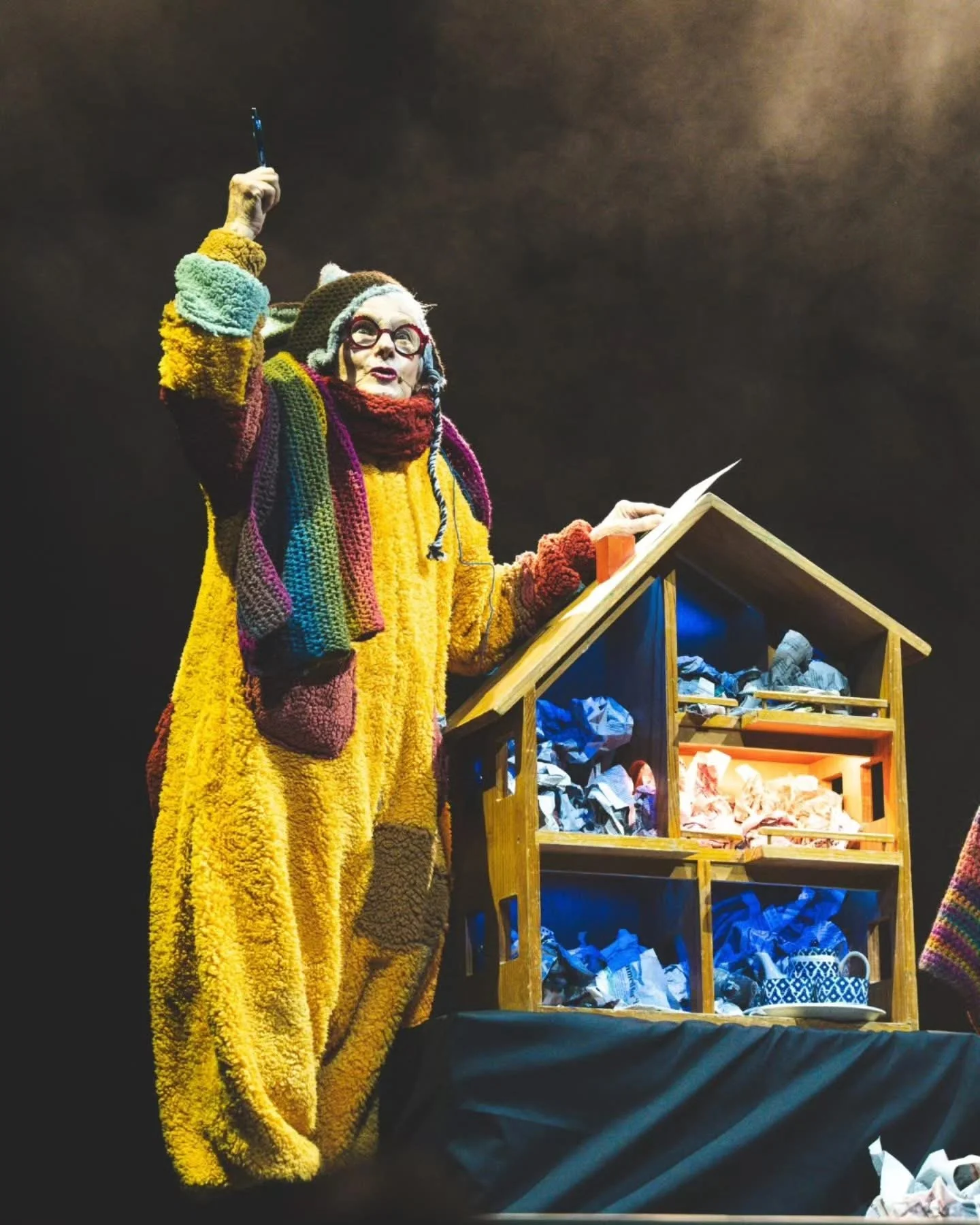
MRS WEAVER: I’m so sick of this. (She scrunches up the newspapers and stuffs them into the house)
TRAV STORYTELLER: She keeps falling through the holes they leave behind and finding herself stuck in a place where only bad trouble lies.
MRS WEAVER: (Dog barks) What did you say? (Dog barks) “Bad stories happen when good people do nothing?” Well I don’t know what to do!
I’m so tired of this. I can’t read the papers without falling into a heap. I can’t weave anymore because I keep dropping stitches. I can't think straight anymore because my mind is in a tangle. I don’t know what to do. I need help.
(Dog barks) (She sits again) What did you say? (Dog barks) No, no no. I can’t. (Dog barks) Alright, alright, alright, I’ll go.
(Mrs Weaver puts on her hat and wraps a blanket around her shoulders)
(Dog barks) No Dog, you can’t come. Look after the house, maybe Platypus will visit. (She breathes in, steps outside/off the rostra)
SND: Outside noise.
(Mrs Weaver is chased and gets to the table, to get smothered by the newspapers. She leaves the table, then arrives back home, takes off her hat and drapes herself over the house)
TRAV STORYTELLER: Mrs Weaver wants to visit Hare, but to tell you the truth, she hasn’t been out of her house for months now.
SND: Writing letter, piano music. (Mrs Weaver pulls pen and paper out of the house and begins to write a letter)
MRS WEAVER: “Dear Mr Hare, it would have been so lovely to visit you this afternoon and partake in a real dinkum afternoon tea, but all the newspapers tripped me up in the garden, yelling headlines that made my ears spin:
(Charlie floats the newspapers above her head. She refers to the headlines)
“It’s all about to explode!” ‘‘Babies starving in the desert!” “Billionaires fly to the Moon!” Bad trouble stories! Could you please come and visit me instead Mr Hare? Signed Mrs Weaver.”
SND: Journey of the letter, on piano. (Charlie travels the letter from Mrs Weaver to Hare. The letter gets to Hare.
Hare reads the letter, then sits up, and starts to move to Mrs Weaver.)
SND: Journey of Hare, live accordion. (She starts to clean up. When he arrives he jumps the fence and ends up scared by the barking, sitting shivering in the pond)
Mr Hare, a little worse for wear! What are you doing in the middle of my pond? Come on. Come inside. (She carries Hare to sit on the house) Are you ok?
(Mr Hare nods) Oh, I’m so pleased! Clean yourself up and I’ll make us a nice pot of tea.
(Mrs Weaver gets tea set from the house, crosses to the table, carrying newspaper and tea. It starts to rattle as she crosses. She places the tea set down and the newspapers whirl around her head…)
SND: [Drone ghost eb in] emanating from the little house. There they are again. Can you hear them? Breathing down my neck. Oh I’m sorry, Mr Hare. I have to sit down. It’s too loud to think!
SND: Drone ghost eb fade out
MRS WEAVER: Can you make the tea?
I don’t want to leave this house full of bad trouble for someone else to clean up, but every time I feel brave enough to begin the sorting, the bad troubles snarl and jump on me. Then I have to stuff them all back in again. It’s exhausting!
SND: Hare theme on accordion. (Hare rattles the tea cup)
What did you say? Time for tea. Always time for tea. I like it piping hot. Don’t you Mr Hare? Milk and a spoonful of sugar.
(They clink their tea cups. A moment of silence)
Did you know tonight is a crescent moon? The crescent moon is a perfect place to sit and watch the world go by. Don’t you think? (They look at the moon)
SND: Hare’s theme on accordion. (Mrs Weave and Hare dance together)
TRAV STORYTELLER: The two friends spent the rest of the afternoon drinking tea and dancing… (They dance, at the end Hare runs along outstretched arms and settles cradled on Mrs Weaver’s hands) …until it was time for Mr Hare to return home.
MRS WEAVER: (He kisses her on the nose) Goodbye Mr Hare. Thank you for visiting.
(Hare travels home via the top of the house. She starts to pick up newspapers)
Mr Hare is right, something rotten and dishonest is always happening somewhere and spending an afternoon with a friend is gloriously restoring.
Hare starts twirling ribbons US of table.
SND: Hare’s theme on accordion. (Mrs Weaver points to the sky DS)
Well look at that, curls of smoke making their way up, up, up! It says: (Reading) “Thank you for a splendid afternoon. Sleep well, Mrs Weaver.”
Oh how sweet!
(To audience) Stuckness is a funny thing. It holds me so tight but then it changes shape and disappears when friends visit.
(Shoving papers into the house) I’ve been hiding my worries in drawers for years now. Every bad feeling, wrongdoing and mistake that rents a space in my mind is shoved out of sight. One day I’ll weave them into my blanket: just not tonight.
SND: Weaving theme on piano. (Mrs Weaver moves her chair under the light of the moon, starts to weave. She sings:
“I see the Moon, the Moon sees me, God bless the Moon and God bless me.
I see the Moon, the Moon sees me, God bless the Moon and God bless me…”
She falls asleep)
SND: Drone (Eb) in. (A low hum as Charlie begins shaking the house)
TRAV STORYTELLER: Bad stories are waking up. Threads of them… (SND: Drone (E) in) …squirm their way through the cracks and across the room. Dog barks louder and louder as the stories creep towards her, weaving around her feet, curling around her legs, up, up, up over her mouth and all the way to the top of her head. And then Mrs Weaver disappears into a chrysalis of bad trouble stories.
SND: Drones fade.
EPILOGUE:
SND: Piano music transforms into the journey of the Book. (Hare sends Mrs Weaver a gift and it lands in her hands. She begins to read - and somewhere over the following, Hare sits down and settles)
MARGI STORYTELLER: Once Upon Another Time, in a faraway world, where magic had stopped whispering in the wind there were three friends: Dog, Platypus and Hare. Every month in the early evening of the full moon Dog, Platypus and Hare would visit The Old Woman who lived next door. They know how important it is to help others on a Full Moon.
“Do you need any help, Old Woman?” says Dog.
(She stands up) “Yes. I’m feeling rather trapped and it’s making me muddled and cross and I don’t know what to do.”
“You need some water. I’ll be back.”
When Dog returns, he’s balancing a bowl of water on his nose.
YouI’ve spilt it!”
Dog licks up the mess, sighs and sits beside her.
“What can I do to help?” says Platypus.
“Oh, I’m feeling so empty, I can’t be bothered doing anything. What’s the point?”
Off swims Platypus and quick as a flash, catches a fat fish. Feeling very pleased with himself, he swims back to Mrs Weaver: “Here's a fat fish for you. Will that help?”
The Old Woman crinkles up her nose, “but it’s raw Platypus!”
“Okay, Old Woman. I'll put it back and let it swim away.”
Finally, it’s Hare’s turn. In a quiet voice, he says: (Hare whispering in her ear) “You look very cold and miserable. Would you like me to light a fire?”
“Oh, yes please. I hate this feeling, it's so uncomfortable. If I knew what to do I would be more comfortable. Oh, no. I mean, if I were more comfortable, I would know what to do. Oh, I'm not sure what I mean anymore. My head is in a tangle.”
Hare builds a beautiful big fire and watches the flames leap and hover and leap again and they remind him of how he loves to leap and bound over the Moon and across the Milky Way. But he can’t leave yet. He has an important mission. He must rescue the Old Woman from her stuckness before it's too late. As suddenly as the flames flicker, Mr Hare leaps into the red hot fire.
The Old Woman cries out: “Hare stop, stop! Come back!” And just then the most magical thing happens: her legs twitch. Her ears grow. Her eyes expand and without a second thought she leaps into the fire. A moment later she reappears holding Hare - a little worse for wear. She twits and tuts in a breathless voice: “Why did you do such a risky thing?” (Hare puts rabbit ears onto Old Woman.)
Then in the clearest of voices her big ears hear:
HARE: (Through microphone) “You know why, Old Woman.”
MARGI STORYTELLER: (She stands up.) Far above her head, beyond the clouds, her big eyes see a Moonbeam moving towards them. Moonbeam gently picks her up. The Old Woman’s legs quiver like Mr Hare’s. Her ears are now very long indeed and her eyes have grown wider so she can see the whole wide world - the bad and the good and up she goes, up, up, up.
“Mr Hare, I’m not sure what’s expected of me…”
Up, up, up. The Old Woman takes a deep breath, begins to let go…to let what is to be, be. And she says…
(The Moon lights just her face a few beats. Blackout.)
END