MRS WEAVER (MY LATEST CHARACTER) AND SOME THOUGHTS
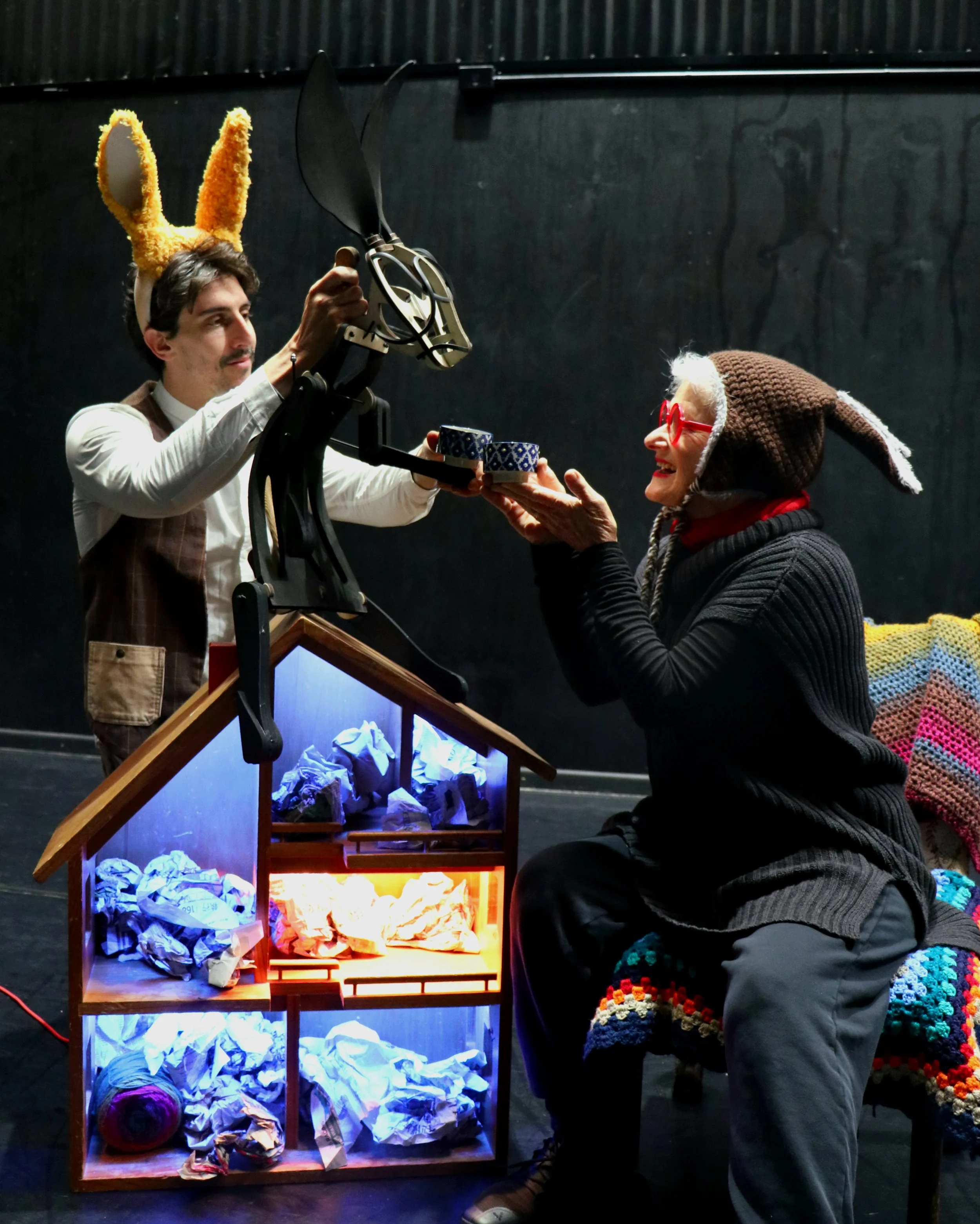
OUR FIRST CREATIVE DEVELOPMENT of the first third of the play was in AUGUST 2025 with DEAD PUPPET SOCIETY ACADEMY, at the PRINCESS THEATRE, BRISBANE. The script was then adjusted to suit a 0-5 age group + parents, after QUEENSLAND THEATRE COMPANY invited us to perform for PlayDays, a program for young ones. November 202
We must “…get in good trouble, necessary trouble, and help redeem the soul of [the world] …good trouble stories help us act, in pursuit of social justice”
(John Lewis, Civil Rights Activist)
Mrs Weaver wants to be born.
And she wants her own show.
I try to tell her:
You’ve had your time”, but she will not shut up.
In fact, she forced herself into the world just over a year ago. She was part of the Dead Puppet Society’s Academy, where she was gifted ten weeks to grow: a class a week in puppetry, followed by rehearsal time for Mrs Weaver to take shape—a beginning.
HERE ARE SOME EARLY IDEAS ABOUT WHO MRS. WEAVER IS: These ideas will shift and change throughout the creative developments we plan on engaging with over the next eighteen months.
Mrs Weaver: She’s 70 years old. Her ancestry is Celtic, and she believes she stands at the threshold of a thin space, that place where the gods and humans meet. A magical spot right on the edge of life. A sacred space that exists between what we’ve known and what we don’t know we know… a place of pause, so that the audience, cast, and creatives alike can look at the world with fresh eyes and recover their sense of wonderment for this miraculous planet. Not a bad brief, “But an impossible one”.
So, who is Mrs Weaver?
• She’s a grandmother (like all old women, it doesn’t matter if they have ‘birth’ grandchildren or are grandmothers to all the creatures and people they’ve gathered throughout their long lives).
• Right now, she lives alone.
• Well, not really. She has a dog, called Dog, and a neighbour called Mr Hare, and all sorts of other friends, including Bird and Bee. The creatures are puppets to be made by the Dead Puppet Society and activated by a dancer/actor/puppeteer.
• Mrs Weaver is a harbinger of tricks and a weaver of stories. She is actively seeking out all the good trouble stories that have been struck dead from the news, allowing room for the bad trouble stories to expand and dominate. She’s had enough time to change.
• She is forced to isolate herself from others after a massive fire engulfes the ridge where she lives, destroying her home.
• Her closest neighbour was Mr Hare, who used to live across the paddock and through the forest. Bee lived in the opposite direction; take the path to the left, not the right. Bird lived around the corner from her house, nesting in the large jacaranda. But she doesn’t know what has happened to them since the fire.
• She now lives in an old caravan that missed the flames. Dog keeps her company.
• Through her interactions with animals, trees and other creatures, Mrs Weaver learns that the very things she wishes to change in the world must first be changed within herself. She remembers Carl Jung’s writing:
If there is anything we wish to change in the child, we should first examine it and see whether it is not something that could better be changed in ourselves
Mrs Weaver read this, and she decided to replace the word ‘child’ with ‘world’. “We need to change the world”, she thought, “but let’s start by changing ourselves”.
How do we change ourselves, thinks the Weaver? Years ago, or so she thinks, Mrs Weaver took a course called “Zen and the Art of Saving the Planet”, where she discussed with others how our choices influence future outcomes: thoughts become words, which then lead to actions. These actions determine what will happen in the world, in our cities, in our towns and even in our homes. ‘Right’ thinking makes the world a better place.
Right thinking, or correct thinking, is something Mrs Weaver struggles with. She wants to feel good trouble thoughts, but every time she does, she gets bombarded with bad trouble stories. And the fire was a very bad trouble story. How do you recover when you lose everything?
When her audience meets her, they see a relatively small, comical woman, elderly in years but with an overabundant amount of energy. You see, she’s determined to make a difference. How? By collecting wisdom from everything that surrounds her, she’s in conversation with animals, birds, insects, trees, shrubs, flowers, clouds, wind, the moon, and rain.
What Mrs Weaver needs to learn is that she must face her truth and fully accept the reality she finds herself in. Dog is always reminding her “You need to closely examine your own actions and decisions before you meddle in something you’re not versed in”. But does she listen?
To begin, she’s determined to create a home of peace and togetherness. Before the fire, not a day went by without a visit from Mr Hare, Bee or Bird. With her creature friends, she wanted to create a refuge. And in so doing, she dreamt of building a community of resistance—no violence, no hate, no despair —until the newspapers arrived with the morning dew, squashed all her plans, and plunged her into deep despair. And then she lost everything.
Throughout the 75-minute performance, Mrs Weaver and her audience despair and delight in many stories, including
1. The importance of showing up for each other, even though sometimes it’s hard.
2. Ways to recover from traumatic events, such as fires.
3. Believing in values such as caring, accepting our differences, and being open to the magic the world offers, if only we believe.
4. Sharing from the heart and hosting our friends with grace.
5. And most of all, embracing the ‘good trouble stories’ that are necessary to create transformative change.
Mrs Weaver believes that grandmothers of the world have a tremendous job ahead of them: there is a reason why they live for 40 or so years after menopause. These years are to be dedicated to initiating and educating their descendants. They need to step into wisdom, listen deeply, and use thoughtful language around the big and small conflicts of the day, and oh my, we have so many, don’t we?